
Zunächst möchte ich Ihnen ein Bild zeigen, damit Sie sehen können, wie viele Buchsen in der Aufhängung verwendet werden.
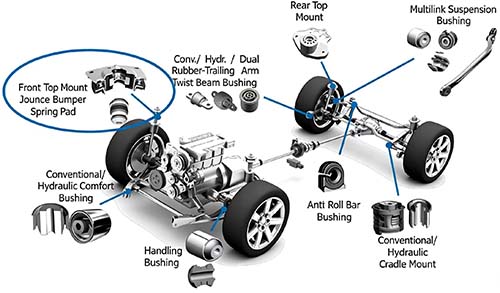
Haben Sie sich jemals gefragt, warum Aufhängungssysteme mit so vielen Buchsen ausgelegt sind?
Die Qualität der Buchsen bestimmt die Gesamtleistung des Fahrzeugs!
Der Grund, warum Aufhängungssysteme mit einer großen Anzahl von Buchsen ausgelegt sind, liegt nicht einfach „in der Komplexität selbst“, sondern ist vielmehr das Ergebnis eines Ausgleichs zwischen verschiedenen Faktoren, darunter Leistung, NVH, Haltbarkeit, Kosten und Abstimmung.
Die wichtigsten Gründe lassen sich wie folgt zusammenfassen:
1. Leistungsanforderungen
Die Buchsen bieten eine „weiche Verbindung“ und sorgen für ein Gleichgewicht zwischen Fahrverhalten und Komfort.
Die Aufhängung ist über Buchsen mit der Karosserie verbunden, die dabei helfen, die auf die Karosserie übertragenen Stöße und Vibrationen zu reduzieren; gleichzeitig gewährleisten sie die Fahrstabilität des Fahrzeugs und erhalten die elastischen kinematischen Eigenschaften der Aufhängung.
Die Buchsen bieten für Komponenten wie Querlenker und Hilfsrahmen eine kontrollierte Steifigkeit in allen sechs Freiheitsgraden: Sie sind in axialer Richtung weich, in radialer Richtung steif und in Torsion einstellbar. Dies gewährleistet nicht nur die Stabilität der Achsgeometrieparameter während der Fahrt, sondern nutzt auch die geringe Verformung der Gummibuchsen, um kleinere Stöße zu absorbieren und dadurch den Komfort einer „weichen Verbindung“ zu bieten.
2. NVH-Anforderungen
Unterbrechen den Übertragungsweg von Vibrationen, um NVH zu reduzieren.
Straßenvibrationen werden einerseits über Federn und Stoßdämpfer und andererseits über Aufhängungslenker und Hilfsrahmen an die Karosserie übertragen. Gummibuchsen isolieren hochfrequente Vibrationen mit geringer Amplitude im mittleren Abschnitt dieses Übertragungswegs und reduzieren die Geräusche im Innenraum um etwa 3 dB.
3. Anforderungen an die Haltbarkeit
Die Buchsen schützen zugehörige Komponenten und erhöhen die Gesamthaltbarkeit des Fahrzeugs.
Die Buchsen absorbieren zunächst einen Teil der Aufprallenergie, reduzieren die Biegebelastung der Kolbenstange des Stoßdämpfers um 15–25 Prozent und verlängern die Ermüdungslebensdauer von Kugelgelenken, Lenkgetriebe und Karosserieschweißnähten um ein Vielfaches; würden die Buchsen entfernt, würden diese Komponenten bald Öllecks, Risse oder ungewöhnliche Geräusche entwickeln.
4. Kostenanforderungen
Die Verformung der Buchse kann Fertigungs- und Montagetoleranzen ausgleichen und dadurch die Verarbeitungskosten senken.
Die Buchsen ermöglichen eine Toleranz von ±1–2 mm beim Schweißen von Blechteilen wie Hilfsrahmen und Querlenkern; der Gummi verformt sich und „nimmt“ Fehler auf, wodurch teure Metallscharniere oder verstellbare Mechanismen vermieden werden können, was die Gesamtfahrzeugkosten um mehrere hundert Yuan senken kann.
5. Abstimmungsanforderungen
Die Buchsen ermöglichen eine mehrdirektionale Anpassung der Steifigkeit und bieten Flexibilität bei der Fahrwerksabstimmung.
Beispielsweise kann bei demselben Satz Fahrwerksbuchsen durch eine einfache Änderung der Gummimischung die Quersteifigkeit von 400 N/mm auf 800 N/mm angepasst werden, ohne dass die Karosserie neu konstruiert werden muss. Für das gesamte Fahrzeug bedeutet dies, dass eine einzige Plattform für verschiedene Fahrstile konfiguriert werden kann, beispielsweise als „Komfort“-Version und als „Sport“-Version.
Zusammenfassung:
„Mehrere Buchsen“ sind nicht überflüssig; vielmehr nutzen sie kompakte, kostengünstige und multifunktionale elastische Gummikomponenten, um gleichzeitig die fünf Hauptanforderungen Leistung, NVH, Haltbarkeit, Kosten und Abstimmung zu erfüllen. Man kann sagen, dass die Qualität der Buchsen die Gesamtqualität des Fahrzeugs bestimmt.
Stichworte :


 Whatsapp :
  Telefon :
  Email :